Buying Your First Pair of Loupes? Let's Break it Down
1. Ergonomic vs. Traditional Loupes
The most fundamental choice you will make is the optical design of your loupes. Your choice impacts your daily comfort and your posture longevity.
Traditional Loupes (Direct Vision)
- How they work: A circle is cut directly into the carrier lens, and the oculars are permanently glued in place.
- The Posture: They require you to tilt your head and neck downward to view the working area.
- The Pro/Con: They offer no ergonomic benefits and can cause neck strain over time, but they have virtually no learning curve.
Ergonomic Loupes (Refractive Vision)
- How they work: The oculars use advanced angled optics that deflect light downward.
- The Posture: This allows you to look straight ahead with a completely neutral, relaxed head and neck position while seeing clearly into the oral cavity.
- The Pro/Con: They eliminate chronic occupational back and neck pain right from day one. Because you are looking straight ahead to see downward, they require a short adjustment period to train your hand-eye coordination.
2. TTL vs. Vario Systems
Once you choose your optical style, you need to decide how those optics are mounted to your frames.
| Feature | TTL — Through-The-Lens | Vario — Adjustable Bar |
|---|---|---|
| Mounting | Oculars are permanently glued directly into a hole cut into the carrier lens. | Oculars are attached to an adjustable crossbar mechanism on the frame. |
| Weight | Considerably lighter because it eliminates extra mounting hardware. | Slightly heavier due to the adjustment mechanisms. |
| Adjustability | Custom-built for you. Fine adjustments can be made with the nose pads and temple arms to ensure the fit is perfect. | Fully adjustable. You can manually change the Interpupillary Distance, Working Distance, and height. |
| Primary Use | The preferred, standard choice for dental professionals' daily custom use. | Ideal as a backup pair, or shared communal/team pairs. |
3. Understanding Magnification & Ideal Usage
For first-year dental students, finding a balance between seeing fine details and maintaining spatial awareness is key. As you map out your educational path and future career, here is a breakdown of who benefits most from specific magnification ranges:
Ergonomic Loupe Recommendations
- 2.5x to 3.0x to 3.5x Magnification : Highly recommended for beginners and those learning to work with optics. These lower powers are ideal for dental students, hygienists, pediatric dentists, oral surgeons, orthodontists, general surgery, and veterinary surgery
- 4.0x to 6.5x Magnification : Excellent for detail-driven students or those moving into more advanced clinical procedures. This mid-to-high range is specifically suited for endodontic students, general practitioners (GPs) and general restorative work.
- 7.5x to 10.0x Magnification : These ultra-high magnifications are designed for highly specialized, minute details. They are the go-to choice for endodontists, general practitioners performing complex restorative work, and specialized jewelers.
- Ergo Trinity : Multiple magnification choices for a diverse range of procedures. This is the go-to-choice for people looking to add options to their work, without adding a lot of weight or multiple sets of loupes.
Traditional (Direct Vision) Loupe Recommendations
- 2.5x to 3.5x Magnification : These entry-level traditional magnifications are frequently used by students, hygienists, pediatric dentists, and orthodontists. They are also popular outside the dental field for hobbyists, pediatric dentists, tattoo artists, estheticians, and lash techs.
- 4.5x to 6.0x Magnification : A great option for those who want higher magnification but are against using ergonomic setups. This level is commonly used by orthodontists, old school dentists, veterinarians, and jewelers.
4. Don't Forget the Light
A high-quality headlight package is just as crucial as your loupes; shadow-free, concentrated illumination completely changes your clinical visibility.
- ProLUX (Corded System): The industry top-seller voted Best Headlight 7 years in a row. It features a lightweight battery that clips to your belt or pocket, providing up to a massive 40 hours of runtime on a single charge and up to 200k LUX of brightness with 4 light settings.
- airLUX (Completely Wireless): For students prioritizing maximum mobility. The battery mounts directly onto your loupes' frame, eliminating cables entirely. It features simple touch on/off controls, delivers up to 75k LUX, and includes 2 batteries that last 3.5 hours each per charge.
- uniLUX2 (The Hybrid Experience): The newest addition offers the best of both worlds combining the mobility of the airLUX with the battery density of the ProLUX. It removes restrictive cable clutter. From your torso while delivering 5.5 to 44 hours of continuous power. Featuring USB-C charging, a built-in safety dimming window, and exceptional color accuracy (95 CRI / 5700K), it is the ultimate modern setup for long clinic days.
- Getting high magnification? Consider the 360 max upgrade!
5. How to Get Fit for Your Loupes
To custom-build your loupes, specific measurements are required to align the optics perfectly with your eyes.
The 5 Essential Details Needed:
- Frame Choice & Color: (Popular student options include the Argon 2 and Classic Petite frames).
- Magnification Choice & Ocular Style: (e.g., Ergonomic vs. Traditional).
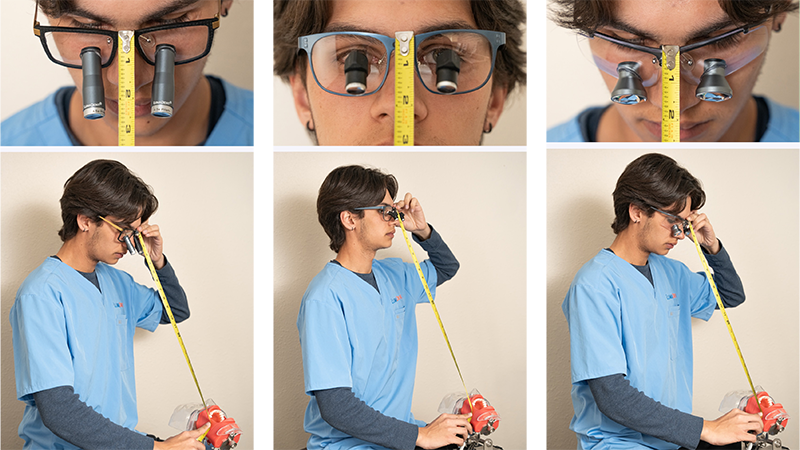
- Working Distance (WD): The precise distance measured from the bridge of your nose down to the center of the patient's mouth. Note: Your physical posture changes depending on whether you use ergonomic or traditional loupes, which will shift this measurement.
- Interpupillary Distance (IPD): The exact distance between the centers of your pupils.
- Prescription (Rx): If you wear glasses, your prescription can be built directly into the surrounding carrier lens at no additional cost.